

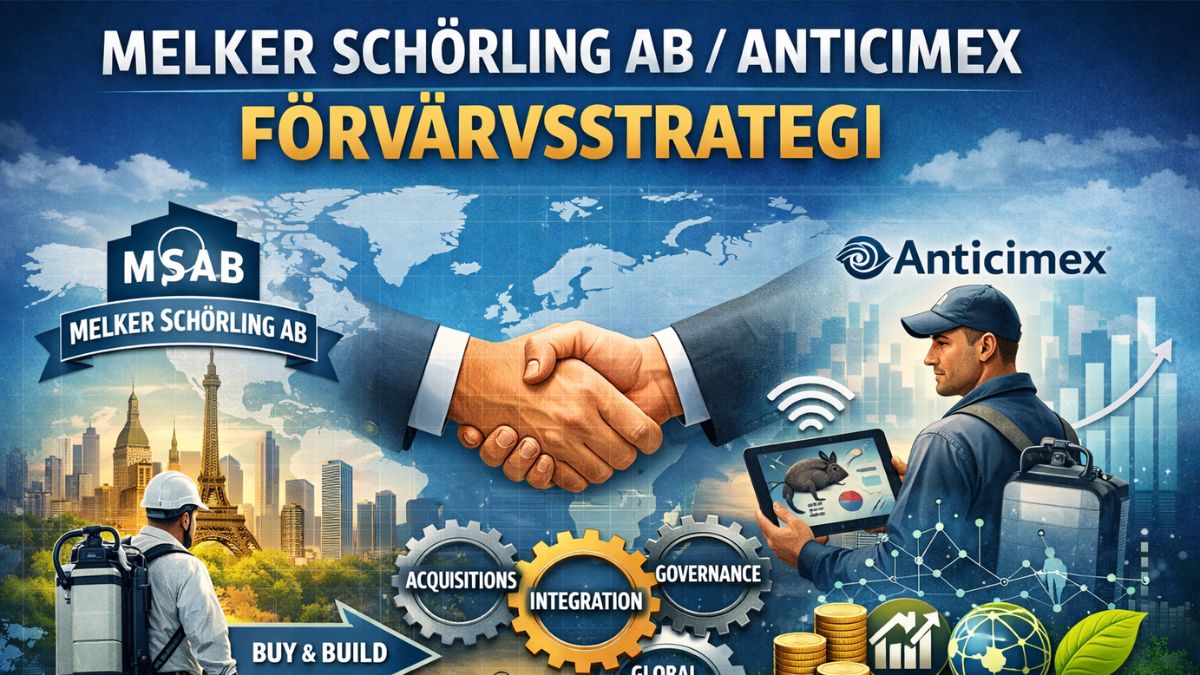
The Melker Schörling AB / Anticimex förvärvsstrategi is a powerful example of how a long-term investment philosophy and disciplined acquisition strategy can transform a regional service company into a global industry leader.
At the center of this strategy are two organizations:
-
Melker Schörling AB – a Swedish investment company known for active ownership and long-term value creation.
-
Anticimex – a global pest control and environmental hygiene services provider founded in Sweden in 1934.
Together, they illustrate how patient capital, technology innovation, and structured acquisitions can drive sustainable international growth.
Understanding the Term “Förvärvsstrategi”
The Swedish word “förvärvsstrategi” translates to “acquisition strategy.”
In the context of Anticimex, it refers to a buy-and-build model in which a strong platform company grows by acquiring smaller businesses and integrating them into a unified operational system.
Instead of relying only on organic growth, Anticimex expanded globally through numerous strategic acquisitions, supported by long-term investors such as Melker Schörling AB.
The Investment Philosophy of Melker Schörling AB
Melker Schörling AB has built its reputation around active industrial ownership rather than passive financial investment.
Key principles of its investment approach include:
Long-Term Value Creation
Unlike many private equity firms that aim for quick exits, MSAB focuses on sustained value creation over the long term.
Strong Governance
The company often participates in board-level governance to guide strategy, capital allocation, and long-term development.
Empowered Management
Instead of micromanaging operations, MSAB supports experienced leadership teams and allows them to execute strategy independently.
Strategic Partnerships
MSAB frequently invests alongside other long-term institutional investors to support large-scale growth initiatives.
This philosophy made Anticimex a natural partner because its industry offers stable demand and long-term expansion opportunities.
Anticimex: From Regional Pest Control to Global Leader
Founded in Stockholm in 1934, Anticimex initially served local markets in Sweden. Over time, it evolved into one of the world’s largest companies in preventive pest management and environmental hygiene.
Today, the company:
-
Operates in multiple continents
-
Serves millions of customers globally
-
Employs thousands of technicians and specialists
-
Focuses on preventive pest control and environmental safety
During the period of institutional ownership, the company completed more than 200 acquisitions worldwide, significantly expanding its geographic footprint.
Strategic Entry of Melker Schörling AB into Anticimex
The partnership began when Melker Schörling AB acquired a minority stake in Anticimex, valuing the company at around €3.6 billion.
The goal of bringing MSAB into the ownership structure was to:
-
Strengthen the company’s long-term shareholder base
-
Add a committed industrial investor
-
Support continued global expansion
Later investment rounds further strengthened the partnership. In subsequent deals, Anticimex was valued at around €5.9 billion, reflecting its rapid global growth.
Core Elements of the Melker Schörling AB / Anticimex Förvärvsstrategi
The strategy can be understood through several interconnected pillars.
1. Buy-and-Build Expansion Strategy
The central engine of Anticimex’s growth is the buy-and-build model.
This involves:
-
Identifying strong local pest control companies
-
Acquiring them strategically
-
Integrating them into the global Anticimex network
The approach allows the company to expand quickly while maintaining local expertise and customer relationships.
2. Industry Fragmentation as an Opportunity
The pest control industry has historically been highly fragmented, with thousands of small regional operators.
This fragmentation creates opportunities for consolidation because:
-
Smaller firms lack technology investment capacity
-
Brand recognition is limited
-
Operational efficiency varies significantly
Anticimex uses acquisitions to combine these smaller businesses into a large integrated platform.
3. Technology as a Competitive Advantage
Technology plays a major role in differentiating Anticimex from competitors.
One of the company’s key innovations is Anticimex SMART, a digital monitoring system that uses sensors to remotely detect pest activity.
Benefits include:
-
Early detection of pest problems
-
Reduced manual inspections
-
Data-driven pest prevention
-
Lower chemical usage
This technological edge allows Anticimex to provide preventive services rather than reactive extermination.
4. Recurring Revenue Through Preventive Services
Traditional pest control often involves one-time treatments.
Anticimex shifted its focus toward long-term preventive contracts, creating recurring revenue streams.
Advantages include:
-
Predictable income
-
Long-term customer relationships
-
Greater financial stability
Recurring revenue also supports continued investment in acquisitions and technology.
5. Active Ownership and Governance
A key feature of the Melker Schörling AB / Anticimex strategy is active governance.
MSAB contributes through:
-
Strategic oversight
-
board participation
-
guidance on capital allocation
-
support for global expansion initiatives
However, operational decisions remain with Anticimex management, ensuring organizational agility.
Global Expansion Through Acquisitions
Through its disciplined acquisition strategy, Anticimex expanded far beyond its Nordic origins.
Key growth regions include:
Europe
The company strengthened its presence across several European markets through acquisitions of local pest control providers.
North America
The U.S. and Canadian markets are among the largest pest control markets globally.
Asia-Pacific
Expansion into Asia and Oceania required adaptation to local climate conditions and regulatory environments.
Through this international expansion, Anticimex established itself as one of the leading global pest control service platforms.
Financial Discipline in the Strategy
Another defining element of the strategy is balanced financial management.
The company avoids excessive leverage and instead prioritizes:
-
sustainable capital structures
-
disciplined acquisition pacing
-
long-term investment planning
This approach protects the company from financial stress during economic downturns.
Sustainability and Environmental Responsibility
Modern pest control must balance effectiveness with environmental safety.
Anticimex emphasizes:
-
reduced chemical usage
-
digital monitoring
-
preventive pest management
These methods improve environmental sustainability while also meeting increasing regulatory and customer expectations.
Strategic Outcomes of the Strategy
The Melker Schörling AB / Anticimex acquisition strategy has produced several significant outcomes:
Global Market Leadership
Anticimex has grown from a regional service provider into a global industry leader.
Strong Competitive Advantages
The company benefits from:
-
scale efficiencies
-
advanced technology
-
strong brand recognition
-
recurring revenue models
Long-Term Investor Confidence
The strategy’s success reinforces Melker Schörling AB / Anticimex Förvärvsstrategi reputation as a patient industrial investor capable of supporting global expansion.
Future Outlook
Several global trends continue to support the strategy:
-
increasing urbanization
-
stricter hygiene regulations
-
growth in digital monitoring technologies
-
rising demand for preventive pest control
Future expansion may involve:
-
deeper penetration into emerging markets
-
further technology innovation
-
expansion into adjacent environmental services.
Conclusion
The Melker Schörling AB / Anticimex förvärvsstrategi demonstrates how disciplined acquisitions and long-term ownership can transform a fragmented industry into a cohesive global enterprise.
By combining:
-
patient capital
-
active governance
-
technological innovation
-
strategic acquisitions
The partnership between Melker Schörling AB and Anticimex has created a powerful platform for sustainable growth.
In a world where many investment strategies prioritize short-term gains, this model highlights the value of long-term thinking, operational discipline, and strategic alignment.