


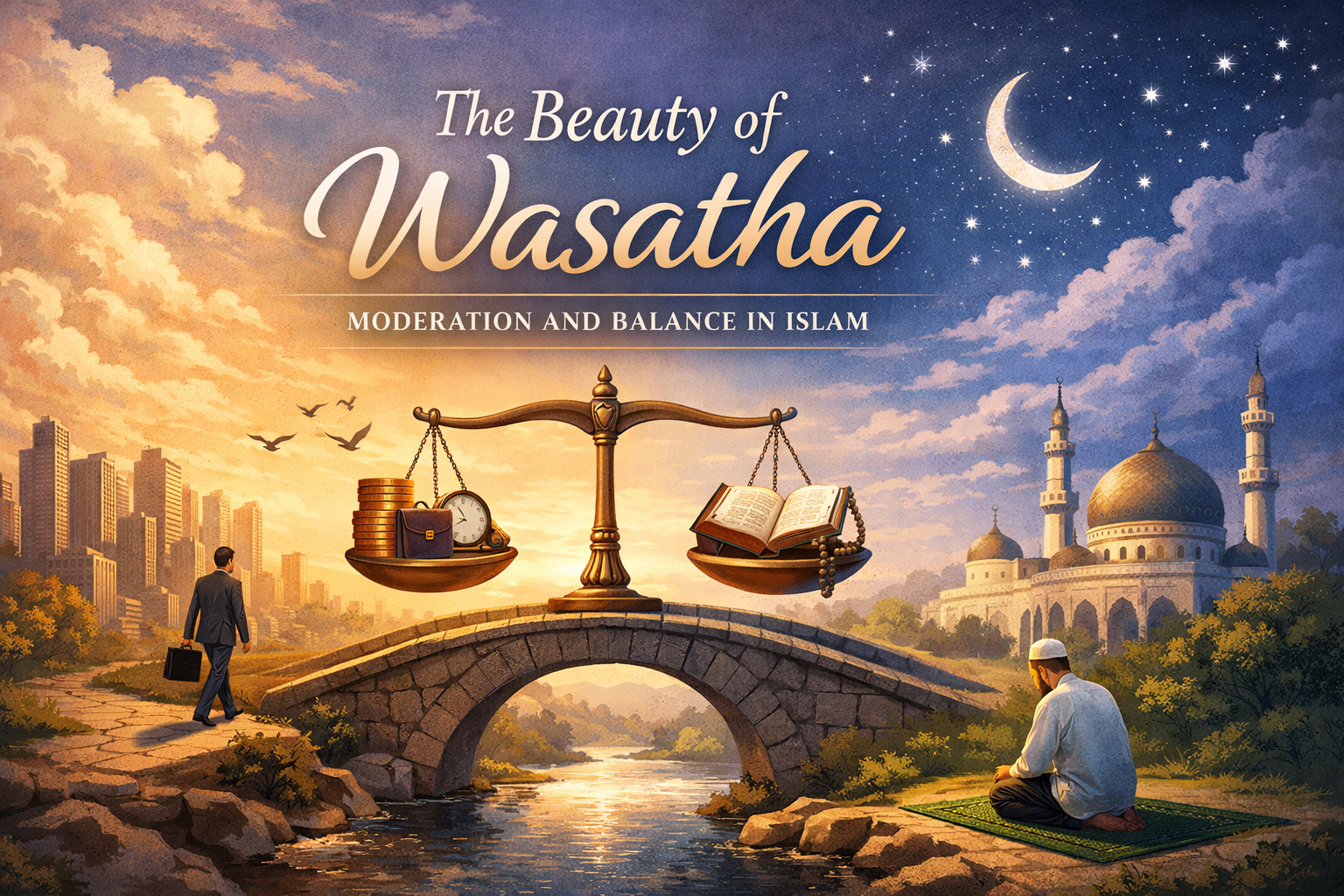
Life often feels like a constant tug-of-war. On one side, there’s the pressure to achieve more—work long hours, climb the career ladder, accumulate wealth. On the other, there’s the spiritual pull—to pray more, seek inner peace, and focus on the soul. Many of us swing like a pendulum between these extremes. We either dive headfirst into worldly pursuits and lose our peace, or we strive for spiritual perfection and burn out.
This is where the concept of Wasatha becomes transformative. If you’ve ever felt overwhelmed by the “all or nothing” mentality of modern life, understanding Wasatha could be a life-changing insight.
What is Wasatha?
Wasatha, in Arabic, literally means moderation, balance, or the middle path. But it goes beyond just “meeting in the middle.” Wasatha is about achieving excellence without tipping into extremes.
Think of a bridge: too rigid, and it snaps under pressure; too loose, and it collapses. The perfect bridge is balanced—strong yet flexible. Similarly, Wasatha teaches us to navigate life with equilibrium. It’s not about being “halfway religious” or “halfway productive”; it’s about becoming the best version of ourselves by avoiding the dangers of excess.
The Deeper Meaning of Wasatha
The Arabic root Wasat conveys more than “middle.” It also means “the best” or “most honorable.” Just as the central bead on a necklace is often the most beautiful, moderation in Islam is not mediocrity—it’s the peak of excellence.
I once spoke with a friend who tried to live a “perfect” spiritual life—praying all night, fasting every day, giving away all his money. Within months, he was exhausted, unhealthy, and resentful. He had fallen into Ghuluw (religious extremism). The Prophet Muhammad (PBUH) showed us a better way: he prayed, he rested, he fasted, he broke his fast, and he married. The middle path respects human nature rather than fighting against it.
Ummatan Wasatan: A Balanced Community
The Quran describes the community of believers as Ummatan Wasatan, meaning “a balanced nation” (Surah Al-Baqarah, 2:143). This balance allows the community to be a witness over humanity. Extremism, whether left or right, clouds perspective.
A balanced community stands for justice, respects both individual and collective needs, and becomes a stabilizing force in a chaotic world. Practicing Wasatha in society means being the one who bridges divides, brings people together, and embodies fairness.
Justice and Balance in Daily Life
Wasatha is deeply tied to justice (Adl). It’s about putting everything in its proper place:
-
If you spend all your time working and neglect family, that’s unjust to them.
-
If you focus solely on spiritual duties and ignore your health, that’s unjust to your body.
Moderation also applies to money. Some hoard wealth; others spend recklessly. A person of Wasatha is generous yet wise, giving, saving, and spending responsibly. This balance brings financial peace that extremes cannot.
Moderation in Worship
Yes, you can have “too much” worship. Islam encourages sustainable devotion. Religion is a marathon, not a sprint. Five daily prayers spaced throughout the day, fasting for one month each year, small but consistent acts of devotion—these all embody Wasatha.
Young believers often rush: memorizing the Quran in a month, praying Tahajjud every night. While intentions are noble, this often leads to burnout. Wasatha teaches that small, consistent actions are more beloved to God than sporadic extremes. It allows faith to remain a source of joy rather than guilt.
Balancing the Deen and the Dunya
Many struggle to balance spiritual life (Deen) and worldly life (Dunya). Some reject the world, believing enjoyment is sinful; others lose themselves entirely in worldly pursuits. Wasatha teaches that the world is a field, the Hereafter is the harvest.
Seek the best of both worlds: work hard, provide for family, pursue education, enjoy life’s blessings—but keep the world in your hand, not your heart. Wasatha transforms success into an act of worship and harmonizes the secular and sacred.
Social Interactions and the Middle Path
Wasatha extends to relationships. In today’s polarized world, people often view others as friends or enemies. Wasatha encourages moderation in emotions. As Caliph Ali (RA) advised: love friends moderately, hate enemies moderately, because roles can change.
Balanced interactions prevent codependency and coldness. Speak truthfully but kindly, uphold wisdom (Hikmah) in timing and delivery.
Avoiding Extremes: Ghuluw and Taqseer
Wasatha is the path between:
-
Ghuluw (excess) – rigid, harsh extremism, loss of compassion
-
Taqseer (negligence) – neglect, laziness, moral decay
Like walking a narrow road, it requires constant awareness and adjustment.
Wasatha and Mental Health
Modern life is a cycle of extremes—burnout, then over-relaxation; overindulgence, then extreme detox. This wreaks havoc on our nervous system.
Wasatha is self-care in action: listening to your body, nourishing your mind, setting healthy boundaries. It brings Sakinah (tranquility), restoring natural balance in mind and body.
Final Thoughts on Living a Balanced Life
Wasatha is a lifelong practice, not an overnight achievement. Life will pull you toward extremes; the goal is to adjust continuously, like a sailor navigating a boat.
Embracing the middle path reveals that you can be both worldly and spiritual, successful and humble, devoted and practical. Wasatha replaces the burden of perfection with a sustainable, excellent pace of life.
In an increasingly divided world, let us be the people of balance, bringing wisdom to confusion and calm to chaos.
Conclusion
Wasatha is more than a word; it is a guiding philosophy. It shows us that the best path is the middle path—avoiding fanaticism and negligence, and embracing harmony for ourselves, our families, and our communities. It is the path of justice, wisdom, and meaningful living.
FAQ
Q1: Does Wasatha mean I can pick and choose parts of religion?
No. Wasatha is about practicing core principles in a balanced way, avoiding extremes of harshness or laziness.
Q2: How can I know if I’m being too extreme?
Signs include burnout, neglect of other duties, constant guilt, or increased harshness toward others.
Q3: Can Wasatha apply to non-religious areas like diet or work?
Absolutely. Eat healthily without overindulging, work productively but rest when needed. It’s about harmony in all aspects of life.
Q4: Is maintaining Wasatha hard in a fast-paced world?
It can be challenging, but the long-term benefits of peace, health, and spiritual fulfillment far outweigh the fleeting rewards of extremes.
Q5: How do I start practicing Wasatha?
Begin with self-reflection (Muhasabah). Identify areas of life receiving too much attention or neglect, then adjust toward balance.